Archive
Weather Station Finishing Touches
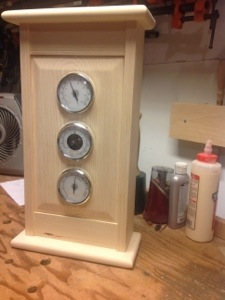
 A few finishing touches and the weather station should be complete. First is to cut the holes for the instruments. Using a compass I drew three circles on the panels and then using my hand drill put a hole in each one to allow me to pass the blade from my saw. I then cut each circle out. I left the holes rough since they will be covered by the instruments.
The top and bottom have curved edges, These are done with a smoothing plane and are very quick. A little sandpaper to smooth the edges and they are complete. A few hours after glue up and clamping and the project is all but done. A nice little project with many lessons. This like my last two projects will have to wait for warmer weather so that i can put a finish on them. Now what’s next on the list????
Weather Station Decisions
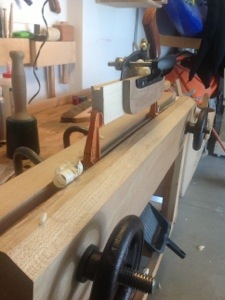 Cutting the grooves for the front panel in each side and in the top and bottom rails required a little engineering. Several months ago I added a guide to my Veritas plow plane. It really helped me guide the plane and improved performance. The only downside is that it is rather large. When I have a narrow board to groove, I am unable to use my bench dogs for support or my Moxon vise since the guide will not clear the vise. My solution which I have shown once before is to insert a bar clamp in a vise and use it to clamp the work. This provides the clearance I need.
Once the grooves are cut I begin making tenons on the rails that will slide into the grooves. I use a mortise gage to mark the end pieces and then use my dovetail saw to cut them out. The nice thing about having a two pin gage is that it is very easy to lay out mortises on several pieces once you have it set up. I cleaned up with a chisel and rails are complete.

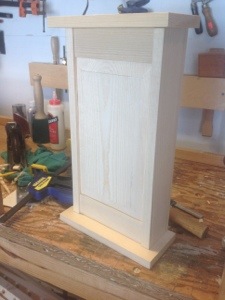
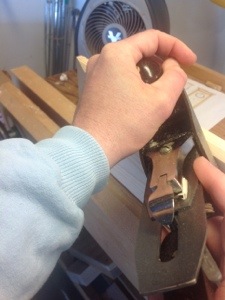
The front panel for the piece is designed as a raised panel. This is all done with a hand plane, in this instance I used a Stanley number 3. Marking off the edges of the panel 3/8″ and the panel at 1″. I placed the panel in my vise and working the ends first began shaving off the material. The picture is very poor so let me describe the process. I angle the plane and begin shaving material from the edge of the board working back and forth until I have cut the reached the lines, I then repeat on the other edge and the sides. This order is important since It allows you to plane off any spelching when you plane the end grain.
Weather Station
A few months ago I began watching videos from Paul Seller’s Masterclass. The first project is a wall clock. Now that I have completed the tool chest and saw till I wanted to to work through some of these basic classes and continue to improve my hand skills. Looking at the project I decided that turning it into a weather station was of more use to me and the face looked more balanced. Going to Lee Valley hardware I was able to pick up three instruments, barometer, thermometer, and humidity.
Considering all of the possible woods for the project I decided to stick with pine because it was easy to access and it followed along with the lessons. If I decide at a later time to use different wood I can pop out the gages and change. I picked up a couple of 1″ x”8″ an cut them to size. Practicing my chisel skills I cut stopped dados in the top and bottom pieces of the weather station. This involved creating a knife wall and then chiseling out the waster from the inside wall. i then used the side that will fit into the slot to mark the other edge and repeated.


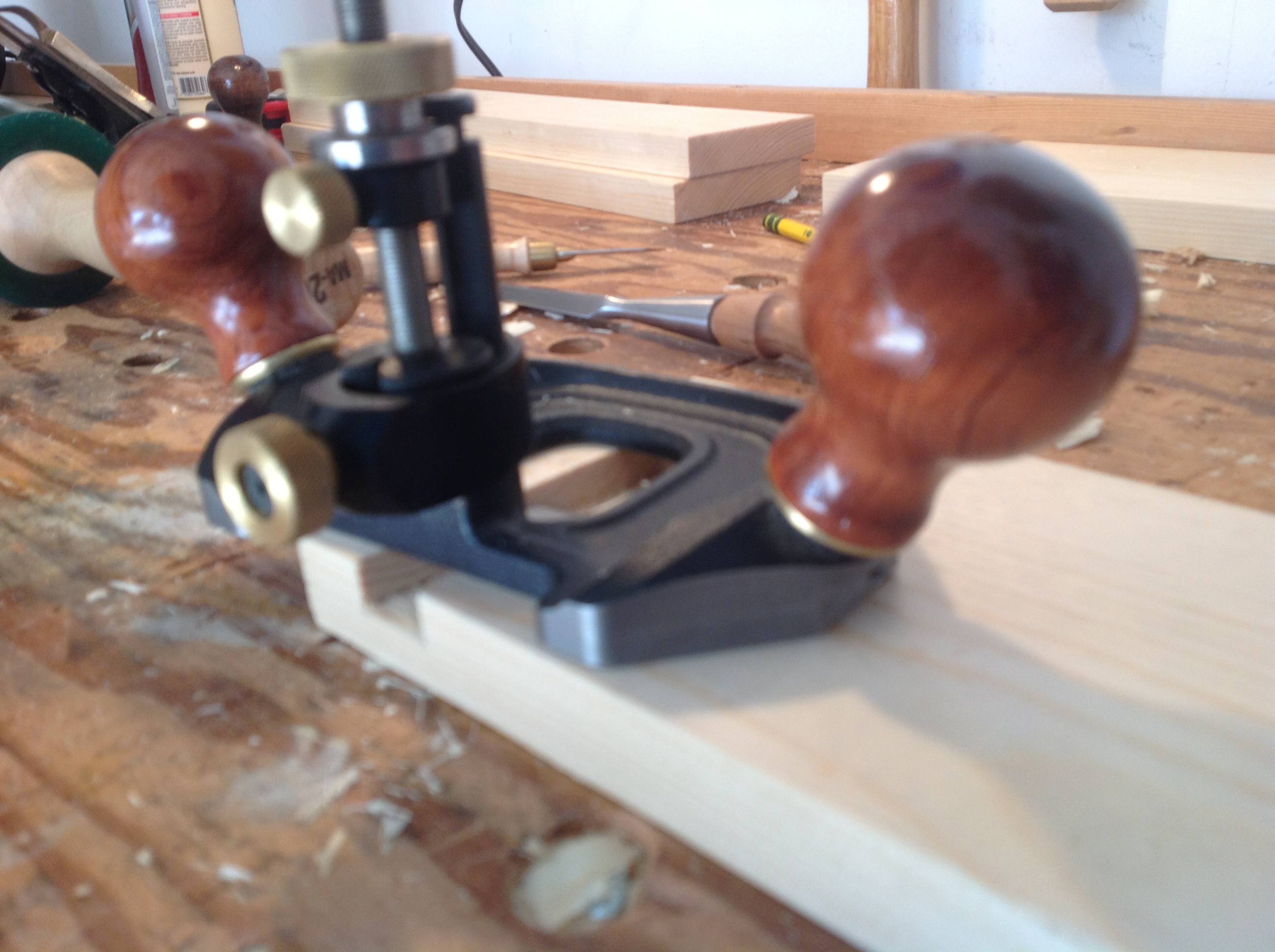
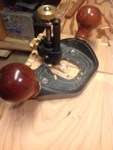
Once I had chiseled out the waste from both sides I grabbed my router plane and cleaned up the bottoms. This allowed me to ensure that the bottom was clean and at the same depth on each side, top and bottom. The dados are slightly shorter than the sides which will allow me to make a step and hopefully leave a clean joint.
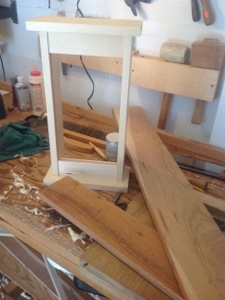
Notice in the photo of the assembled top, bottom and sides that the sides hang off the back by 3/8″ this is the amount that I will notch from the front to get a nice fit. In order to get this step correct I install the sides and using clamps force them into place. A marking knife its then used to mark the sides. I cut the notch with a saw and chisel and reinserted the sides. With enough time I will hopefully get this completed next week.


Saw Till French Cleats
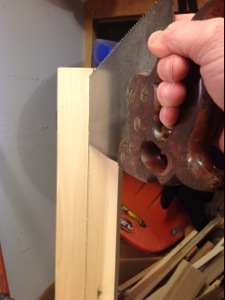
 After searching for my stud finder for a couple of days “literally” I located where I want to hang my saw till and found some scrap poplar to make the cleats. It’s roughly 1″ x 6″ x 24″ but I’m not measuring. I grabbed a straight edge and pencil and marked off the position of the saw cut. the angle across the end is 45 degrees.
Next I used my marking knife to define the lines. looking around the garage I thought that the best way to make this cut may be using my table saw with the blade angled. Realizing that it still has a dado blade installed, pushed up against the wall and has a whole pile of “crafty stuff” piled around it, perhaps I could do this with a hand saw.
The term “crafty stuff” refers to the many projects that my wife gets involved in that is above my comprehension. There are some rules about “crafty stuff” the most important being…If I move it-it will break, if it breaks it will be my fault…..etc. Suffice to say sometimes it is best to leave crafty stuff alone.
I have not used power tools on this project to this point and why start now!

Clamping the wood into my vice I grab my dovetail saw to make an initial cut. My thought is that if I begin with this saw I can get a good start and switch to my handsaw which doesn’t have the back. I progress down the cut switching to my hand saw when the back is touching the wood.
My handsaw is a Disston D8 that I picked up on Ebay about a year ago. It is filed rip at 5 1/2 TPI. I really like this saw and looked for a few months before finding it. The handle fits my hand very well. I sent it to Bob Rozaieski at Logan Cabinet Shoppe to have it sharpened and was amazed at how quickly it saws. Additionally Bob answered many questions and since, I have had him sharpen other saws.
I progressed down the board moving it up in the vice a few times until I reached the last couple of inches. At this point instead of turning the board over and starting from the opposite end, I flipped the saw over and completed the cut. Seemed logical to me and worked, although I haven’t seen anyone else do this. The cut generally followed the line and I only had a few passes with a plane to clean it up. This was quicker than using the table saw! I think it has taken longer to write about it and correct all of the mis-spellings.


Next I grabbed a few screws and attached one side to the wall and the other to the saw till. When the weather stays above fifty I will add a couple of coats of shellac.
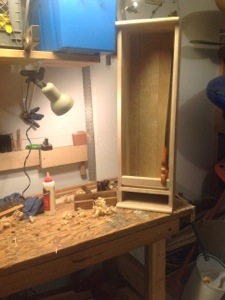
The other piece I added was a small divider to keep my saws separated, which is in the back of the till. I just glued it to the two outermost boards of the back to allow for movement. Finally I have all of my tools off the bench and safely stored away and if you notice a couple of empty slots for some different saws!

Saw Till Shelf
The sun is out and the thermometer is hovering near 50 degrees. Opening the garage door the light has flooded into my corner of the garage and I can hear the birds chirping outside. I feel like a prairie dog cautiously lifting its head above the burrow and looking around. Woodworking in natural light is a great improvement and I’m looking forward to a long list of spring projects.
Today before I begin something new, I plan on tackling one of those projects that has lingered long enough. The tool chest is complete and I have cleared my bench of tools, but there remains 5 saws that have cluttered up the top of my cabinets for months. Dusting off the carcass of my saw till I struggle to recall what I have to do to finish it up and make room for new projects.
Glueing together two boards I prepare to make a shelf to divide the saws from a future drawer. Then after planing it square and to the correct thickness, I cut dados across the till sides. First I mark the bottom of each dado with my square and marking knife. Using a chisel; a knife wall is created and I cut the side of the mortise with a saw using the wall as a guide. Placing the shelf in the slot, the marking knife is used to mark the other side and a second knife wall cut. Eventually I use my router plane to complete the slot. This is repeated on the opposite side. Final fitting of the shelf is done with my plane.
I now need to decide on a piece to support the saw handles and hold the saw in place. Shannon Rogers in the Hand Tool School mortised a piece across the front of the till covering the shelf joint. I have decided to go a different route and create a mortise and tennon joint and inserting a cross piece to hold the saws. The crosspiece is cut to size and to add a little change in the till I decide to round over the top. I have one pair of hollows and rounds and this seems to be an ideal time to try them out. The wooden planes make short work of the cross piece and I went ahead and rounded the top and bottom of the till to match. I use Paul Sellers mortising method to cut mortises on each side

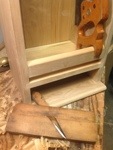
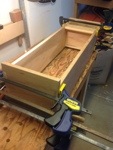
After test fitting the cross piece and mortises I glued up the case using hide glue. All went together well and I now have most of the components for the saw till. Remaining on the project is to install the back, make french cleats to hang the till onto the wall and come up with some means to separate the saw blades on the back of the till. Another day and I should be done. I am very excited to get my saws off of the bench and move onto other projects. Now if I can just figure out where the wall studs are…………..


 orepass