Archive
Drawer Bottoms


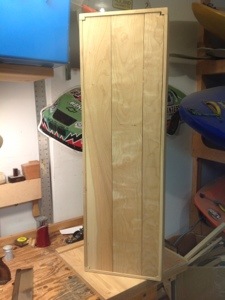
The drawer bottoms are straight forward. After milling poplar boards down to 1/2″ I glued them up to the required width. I was a little sloppy with the glue so it took a little time to clean up, then finish plane with my #4 smoother. Since I decided to deviate from Chris Schwarz’s plan to nail the bottoms to the sides, I needed to rabbit the edges to match the 1/4″ groove. I used my Veritas Rabbit Plane (moving fillister). I find this plane a little finicky to set up, but once I have the blade at 90 degrees it works wonderfully. The shavings come off in a nice twist. A nice component on this plane is the nicker which makes cutting across the board neat and clean. I considered doing this part on the table saw with dado blade,s but after I had the plane set it went so quickly, I did it by hand.
Tomorrow I will look at the fit of my tools in the drawers, then glue them together. Looking around the garage it appears that I now have all of the components to finish the Tool Chest. Time to start thinking about the next project!
Tool Chest – Drawer Dovetails
My wife’s heater appeared in the garage this morning so I put it to work. With a little extra heat I was able to finish cutting the dovetails for the last drawer.
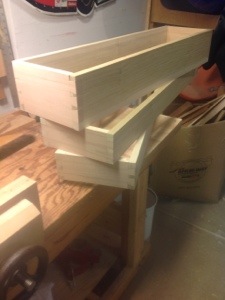
Next I planed stock for the bottoms down to 1/2″ and prepared to cut a groove into the drawer sides. In the Anarchist Toolchest the drawer bottoms are nailed to the bottom of the drawers. This appears to have been done for ease of installation and to enable replacement of the bottoms should they wear. Since I used Oak on the sides of the drawers where they contact the runners, I don’t think wear will be an issue. I much prefer to place the drawer bottom in a groove. If you have been reading my blog you are probably think yeah, yeah, yeah it’s just an excuse to use the plow plane, and you are correct. The small veritas plow plane has become my favorite tool. I like the feel of the wood curling up over my fingers and the sound it makes cutting a groove. I set the plane up to cut a 1/4″ grove a little over a quarter inch from the edge of the board.
Cutting the sides went well and I cut the groove through the end of the board knowing that the small groove will be hidden by the drawer runners and that if I desire I can place a plug into the groove. Using my gramercy holdfasts it was quick work.
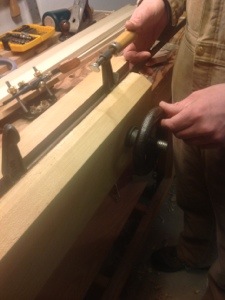
When I set up to groove the drawer sides I realized that the short length was going to pose a problem with holding the boards in place. The holdfasts did not prevent the sides from twisting away from the plane. The ends of the drawers required a different holding plan.
Placing one of my clamps in my Moxon vice I was able to secure the side and allow plenty of room for the guide of my plow plane to pass over the vice. I placed a spare piece of wood under the drawer side and plowed the groove.
Once all of the groves were cut I will trim the bottom boards down to size and test fit them into the drawers. Two more to go and I’ll be ready for glue up.


Toolchest – Drawers
There have been several posts concerning the drawers in the tool chest. Many of them deal with the softer wood used in the chest to keep it as light as possible. Wear along the drawer bottoms appears to be the problem with many people advocating the use of a harder wood for the runners and glued to the bottom of the drawer sides. My chest has been made out of poplar because of the weight and lower cost so I have been considering my options and have come to the conclusion that it is already too heavy to manhandle and I should use any wood that suits me! Now there’s a bold statement.

In the end I will use oak for the runners and the sides of the drawers. This should place the harder wood at the wear points and keep the cheaper poplar along sides. The first step is cutting all of the runners and support. This must be done first so that the drawer measurement is accurate. I measured and cut apiece of Oak that is 1 1/4″ wide to support the bottom drawer and the runner fro the second drawer. This runner is supported by the saw till guide and a support in the corner of the chest which is 1″ square oak. The next runner sits on top of this one and is the width of the chest. The top drawer will sit on this runner. The photograph shows all of the runners and drawer slides in position.
All of the drawers are dovetailed together. In the book Chris Schwarz nails the drawer bottoms on. I could not bring myself to do this. Since I used oak sides for the drawers I feel confident that the drawer wear will be under control. The botttoms are made of two pieces of popular 1/2″ thick with a 1/4″ rabbit around the sides. To control movement I will ship lap the boards.
As of this post I have completed dovetailing two of the drawers before being driven out by the cold. My little heater managed to creep the temperature up to 30 degrees but it was not enough. I’ll have to wait for warmer weather, hopefully next weekend it will get into the low 40’s.
Tool Chest – Saws
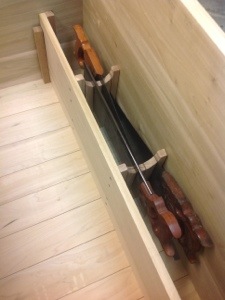
I am moving along with the inside of the chest and planning where to place my various tools. The saw till needs to hold two handsaws, a tenon saw and a dovetail saw. I have a couple of other saws, but I will keep them in the other saw till I have been building along with this project. (Think reading two books at the same time is difficult? I actually have three projects underway in the garage!) The two handsaws are fairly simple since they are approximately the same size, the tenon saw is much shorter, but has a deep saw plate so as long as I can support the saw in two places it should work well. The dovetail saw is a problem unto itself. It’s short length and shallow saw plate may require a totally different solution.
 Using the dimensions in the Anarchist Tool Chest I cut two boards to the same width and height. Since the ash I was using is prone to chip along the saw cut I used a technique from Paul Sellers and used my marking knife to make two parallel lines roughly the width of the saw kerf. Cutting between the lines I was able to get very clean, chip free edges.
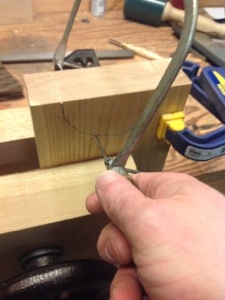
I then marked the semi circle on the pieces using a compass, clamped them together and cut the curve with a coping saw. Next time I will make sure I have spare blades handy. I placed sandpaper around a piece of pipe and used it to sand the curves smooth. I used the table saw to cut the grooves for the saws. Carefully cutting a groove on one side, turning the piece over to get a matching groove on the opposite edge, then repeating on the second piece. Once all four grooves were cut I cleaned them up with a hand saw.

Next I cut a piece of poplar to fit the length of the chest and four pieces of oak to attach the till to the sides. Using my # 4 Stanley Plane I quickly smoothed all of the boards cleaned up the corners and stared blankly into the chest.
I needed to step back and carefully plan the position of the till pieces to optimize the use of space, support the saws and hopefully identify a spot for my dovetail saw. Supporting the hand saws and the Large Tennon saw demands that the till pieces be spaced no further apart than 11″.


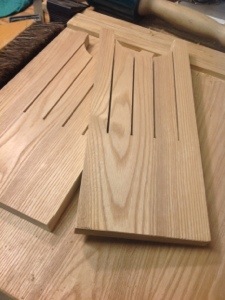 I drilled holes for four 1 1/2″ screws in each of the till supports. I have not used a power drill since I picked up my Millers Falls Drill. The ability to carefully control the drill speed and position makes it very accurate and less likely to chip the wood at the exit of the hole. It also looks cool and only cost $7 with bits included! I screwed the supports to the board and placed it into the chest. I plan on using some polyurethane on the till pieces and on the guides used on the board. It should make a nice contrast.
I can see a place for my dovetail saw on one side of the saws and will make a support to hold it. Next step… finishing the drawers and drawer slides. Hopefully it’ll be warmer next weekend.
Writing Desk – Part 2
Continuing from the Writing Desk-Part 1 there are more hints to its past:

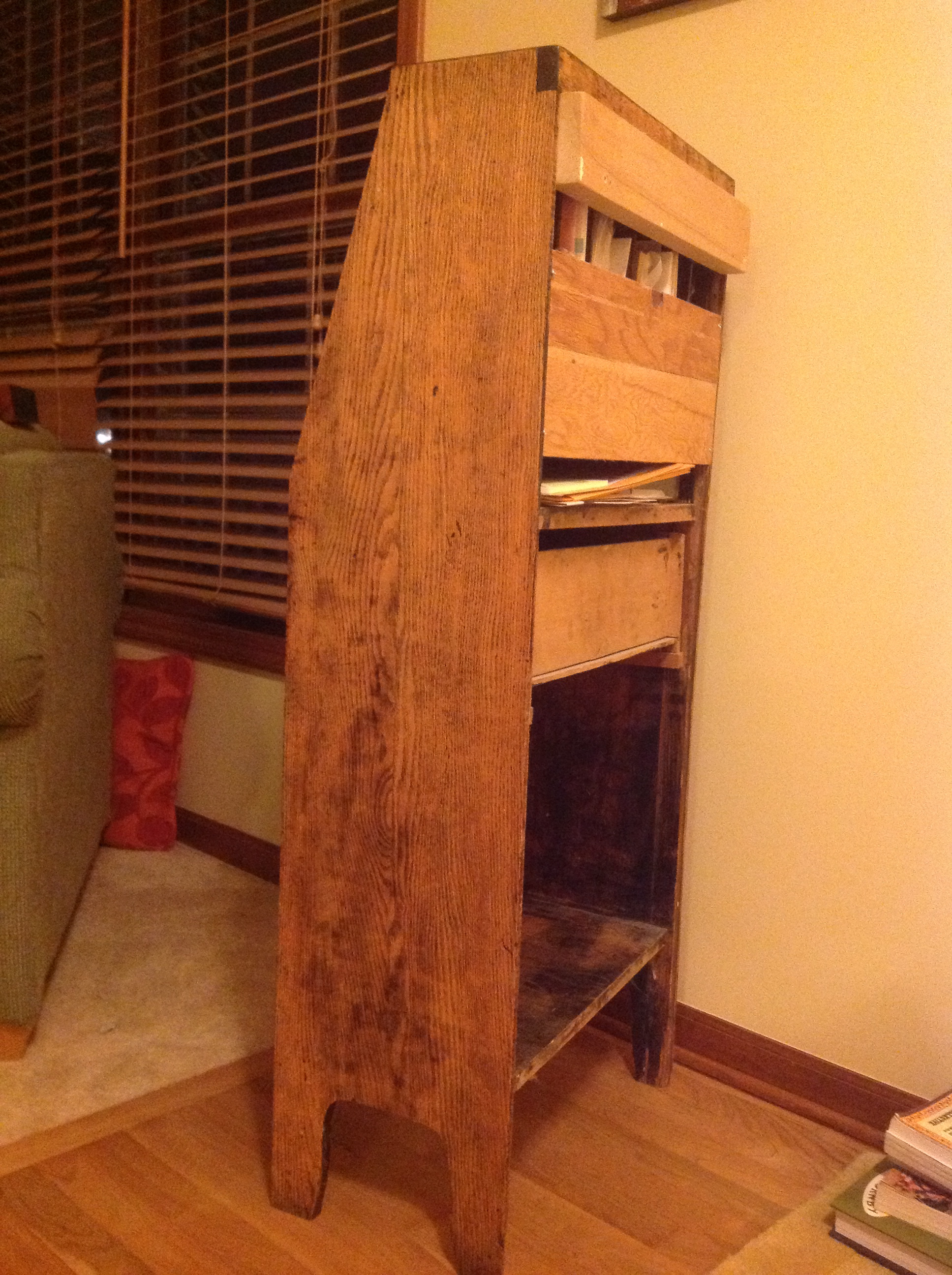
Turning to the right side of the desk a single quarter sawn oak board rounded on the outside edge supports the desk. The left side, however is of an entirely different species consisting of two boards stained in an attempt to match. Comparing the two pictures it is very difficult to see the difference. If you click on the picture on the right it will enlarge and you can see that the wood is clearly not quarter sawn oak and does not match the left side.
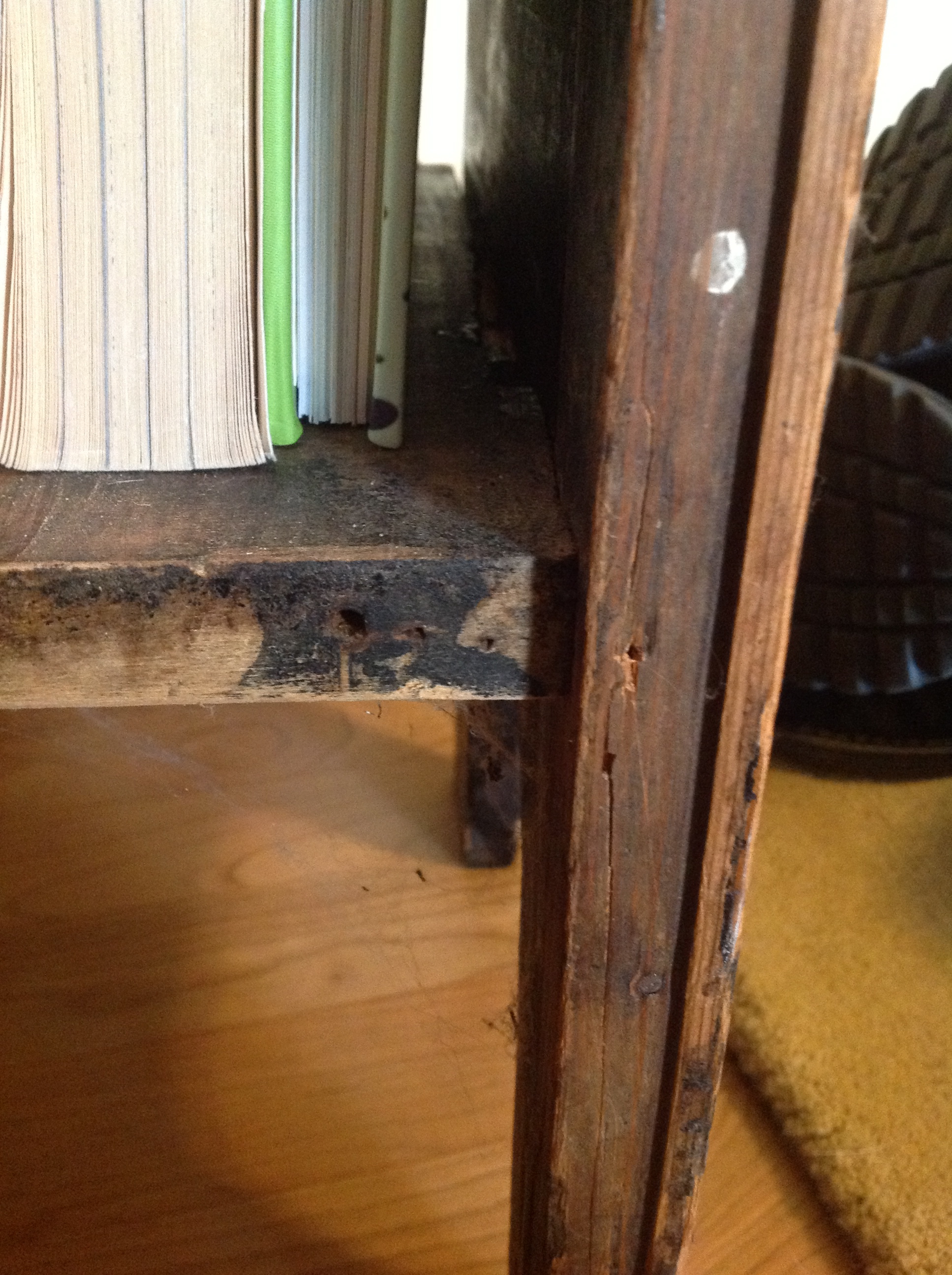
Turning the desk around immediately reveals that the back is missing. A piece of plywood is crudely screwed to the back of the cubby holes to prevent papers from falling out. There is clear evidence that there was a back attached at one time. A rabbit runs down the right side and there are nail holes in the shelves. The left side is again different: A rabbit has been cut along the left side of the desk, however the drawer slides and shelf are not dovetailed into the side, instead they are attached with nails. Images can be enlarged if you click on them.


In summary we have a simple quarter sawn oak writing desk that is rather appealing. It has simple clean lines, works great but has a few adaptations.
A lock that is covered with a handle, an entire side that is replaced with a different species of wood, changes to the attachment of the shelves that is clearly done by a different woodworker. A missing back and evidence that this piece was painted black at one time and then restored. A few phone calls and there are a couple of different possibilities.
1. My wife’s great grandfather earned his living moving from farm to farm threshing grain. In payment for threshing, items were often taken in trade: furniture, food, tools were all exchanged. Could this desk have been made and bartered.
2. My wife’s grandfather would trade food from his garden to workers at the local steel mill in exchange for items he could not make himself. A 50# bag of potatoes brought home many useful items.
3. Like many people growing up in the 30’s and 40’s, other peoples discarded items could be rebuilt and repurposed. Discovered in scrap yards and dumps entire homes could be furnished with quality items. Many of us continue to rebuild wonderful items from the past.
Scanning the internet my wife found a picture of a similar desk attached to shelves. Could this desk have been part of a larger unit?

Spend some time looking around your family’s home, maybe there is a little history to discover and share.
Writing Desk – Part 1
There is a small writing desk by the front door that arrived with my wife. It has traveled around the country from apartment to home. It has seen dogs come and go. It suffered the indignity of being attached to a wall so children could not topple it. The drawer handles were removed because there are no drawer stops and little hands kept pulling them open. This week I was walking out the door took a second glance. That small writing desk has a story to tell:
The desk is very simple in design. Constructed of quarter sawn oak it stands 3′ 10″ tall, 20″ across the front and 11″ wide. It is contains a shelf at the bottom, a single drawer with a lock and a writing desk carefully carved. The desk’s simplicity (not its photograph) catches the eye.
Opening the writing desk leads to the first piece of curiosity. At first it looks like a very simple drawer pull used to open and close the writing surface, but as you move closer you can see that the pull is nailed onto the desk and once opened a lock is revealed.
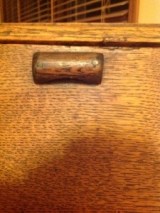

Perhaps the key was misplaced and the pull installed to allow easy access to the desk? The interior of the desk contains typical cubby holes for letters and envelopes and a drawer for other small items. The entire structure containing the cubby holes and drawer is supported by a board nailed to the top of the chest. It hangs down as if by magic, leaving room underneath and to each side for bigger items.
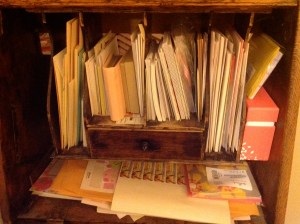
My wife wants to note that all items in the desk were staged for the photograph. I want to note that I didn’t know there was anything in the desk – I’m going back outside now…..
Tool Chest Hardware

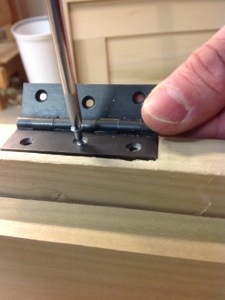
I spent a couple of days looking around local stores for hinges that would work for the tool chest. It is very difficult to find narrow hinges that will work on the 7/8″ carcass. Finally I ordered hinges and a lock set from Horton Brasses. They seemed expensive, but are very well made and operate smoothly. I’m thinking money well spent and will add to my tool roll for future reference.
Traditionally when installing hinges, I have used a powered router and a chisel in the corners with varying success. On the chest I did it all by hand in less time, with much better results. The hinges were laid out using a marking knife and round mortising gage, then I deepened the marks using a chisel. I adjusted my hand router to a portion of the total depth and after a few passes reached final depth and cleaned up with a chisel. Drilling the screw holes with my eggbeater drill gave me good control and I attached the hinges with the steel screws included in the package from Horton Brass. They also sent brass screws which I will install when the tool chest is complete. Best of all, I didn’t all in the living room while the shop was too cold to work.

Toolchest – Oops and other bad words
This post was supposed to contain the final glue up of the toolchest lid and skirts but………it will now be written as:
Oops how to adjust your skirt after the clamp slipped.

The weather finally peaked above freezing and with a weekend that looked unseasonably warm it was the perfect time to make the final glue up and prepare to paint. The bottom skirt and lid were in place and with help from my son it all went reasonably well. The upper skirt was fitted and trimmed, clamped in place and left overnight to glue. Feeling rather spry this morning and preparing for my son’s soccer game, I took the clamps off and moved the chest into the garage ready for the final scraping and adjustments. Placing the lid on top it quickly became apparent that something was not right. There was a 1/4″ gap between the lid and the skirt on one side. Visions of quick fixes, plane work, repairs, danced in front of my eyes until one solitary thought lingered, the hammer. No not the rubber mallet or the framing hammer, but the “double jack” some people may call it a sledge hammer but to an underground miner it will have that unique name. A few taps here a quick wack there followed by an endless pounding would certainly relieve my frustration, but alas I needed to get to that Soccer game so fortunately the chest, however disfigured was spared.
A couple of hours later with a clear head I began removing the front of the upper skirt. I did this carefully by cutting across the width with a saw then carefully separating the skirt from the carcass using a chisel. It came away with little protest leaving some wood to be pared away with a chisel. I carefully cleaned up the tails from the prior joints and began looking for a replacement piece of lumber.
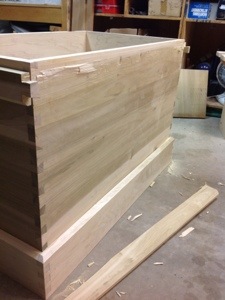
After loosening the side rail I was able to position the replacement skirt and mark out the pins for the dovetail joint. Another hour or two of drying and the glue would have made this much more difficult. The second round of gluing and clamping went much easier with the two sides already glued in place.
Making mistakes is part of the learning process and without them our education would be incomplete. After the initial frustration passes the challenge of finding and implementing a fix can be quite enjoyable and when the results leave the carcass unblemished no one will know. Much of the furniture I have made has stories to tell and as you know many of the pieces we see in museums have unique characteristics and stories waiting to be discovered.
Now onto that scraping….

Pink Planes
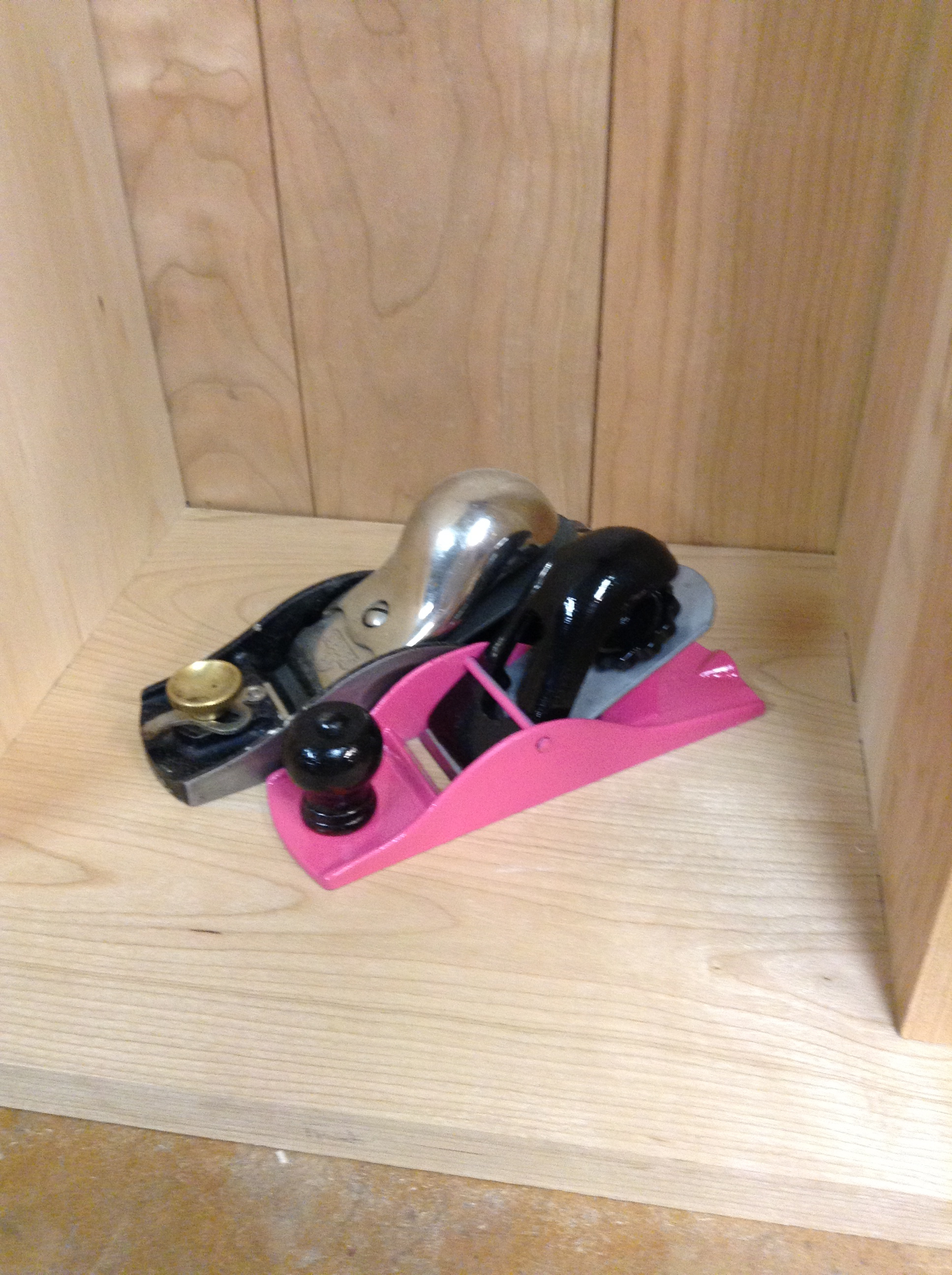
If you haven’t looked around the blogs lately you may have missed some pictures and articles about children in wood working. The Literary Woodworker posted a wonderful picture of his crew helping him on a project, Paul Sellers is offering to take some of his time at The WoodWorking Shows to teach children and now A Pink Plane!
When Grandpa came for Christmas he brought along a couple of special gifts. A gentleman’s saw, block plane and this very unique and highly prized pink block plane. If you want one like it, you’ll have to make your own, but for now enjoy the picture of the one that resides in my daughters hand.
Back of the Saw Till
Several weeks ago I began the process of building a home for my handsaws. Admittedly I don’t have a handsaw problem…yet, however I do have a tool problem. I need a home to store them safely and this is why I have been building the tool chest and along the way a saw till. Following along with Shannon Rogers and the Hand Tool School I have built the saw till carcass and have reached a point where I need to prepare and install the back.
I prepared three boards approximately 1/2″ thick and then planned to cut a rabbit in the back of the carcass to support the boards.


Cutting the Rabbit along the inside of the carcass did not turn out as simple as it first appeared. Working without a plan sometimes gives you unexpected opportunities. In the case of the saw till the first chance to try a new skill came when I realized that I had not positioned the dovetails to hide the rabbit. I now had the job of cutting stopped rabbits that would not be exposed on the sides of the carcass.
I used my skew rabbit plane to cut the majority of the groove then using a chisel to finish them up leaving some material in the corner. Took a little more time than it should have, due to the chisel work but I am pleased with the result.
The back will consist of three boards and I have a choice of ship lapped joints or tongue and groove for their installation into the rabbit. After my great experience with tongue and groove on the tool chest bottom boards I decided to try it again on this project.
 I installed the 1/4″ cutter on my plow plane and proceeded to plow a groove on one side of the two outer boards. The other edge of these boards will rest against the carcass. I then notched the corner of these boards to fit the notches in the carcass.
As I mentioned in a previous post making the tongue for the joint using the veritas plow plane requires the installation of the conversion kit and blade. This is a simple process and only takes a couple of minutes to complete. One caution…clear an area of the bench so you can spot the screws and washer. I managed to drop the washer in a pile of shavings and for a couple of tense moments thought I had lost it. The pictures below show the additional skate which is part of the conversion kit. It is installed onto the plane and the blade fitted between this skate and the main skate.


After 10 minutes I have placed a tongue on both sides of the middle board and installed all three into the back of the till. A few more parts and I can get my saws safely off my bench and out of the way.


 orepass