Archive
Toolchest – Oops and other bad words
This post was supposed to contain the final glue up of the toolchest lid and skirts but………it will now be written as:
Oops how to adjust your skirt after the clamp slipped.

The weather finally peaked above freezing and with a weekend that looked unseasonably warm it was the perfect time to make the final glue up and prepare to paint. The bottom skirt and lid were in place and with help from my son it all went reasonably well. The upper skirt was fitted and trimmed, clamped in place and left overnight to glue. Feeling rather spry this morning and preparing for my son’s soccer game, I took the clamps off and moved the chest into the garage ready for the final scraping and adjustments. Placing the lid on top it quickly became apparent that something was not right. There was a 1/4″ gap between the lid and the skirt on one side. Visions of quick fixes, plane work, repairs, danced in front of my eyes until one solitary thought lingered, the hammer. No not the rubber mallet or the framing hammer, but the “double jack” some people may call it a sledge hammer but to an underground miner it will have that unique name. A few taps here a quick wack there followed by an endless pounding would certainly relieve my frustration, but alas I needed to get to that Soccer game so fortunately the chest, however disfigured was spared.
A couple of hours later with a clear head I began removing the front of the upper skirt. I did this carefully by cutting across the width with a saw then carefully separating the skirt from the carcass using a chisel. It came away with little protest leaving some wood to be pared away with a chisel. I carefully cleaned up the tails from the prior joints and began looking for a replacement piece of lumber.
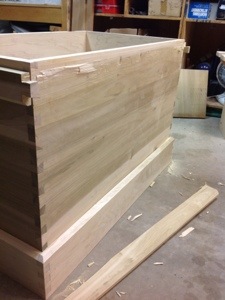
After loosening the side rail I was able to position the replacement skirt and mark out the pins for the dovetail joint. Another hour or two of drying and the glue would have made this much more difficult. The second round of gluing and clamping went much easier with the two sides already glued in place.
Making mistakes is part of the learning process and without them our education would be incomplete. After the initial frustration passes the challenge of finding and implementing a fix can be quite enjoyable and when the results leave the carcass unblemished no one will know. Much of the furniture I have made has stories to tell and as you know many of the pieces we see in museums have unique characteristics and stories waiting to be discovered.
Now onto that scraping….

Pink Planes
If you haven’t looked around the blogs lately you may have missed some pictures and articles about children in wood working. The Literary Woodworker posted a wonderful picture of his crew helping him on a project, Paul Sellers is offering to take some of his time at The WoodWorking Shows to teach children and now A Pink Plane!
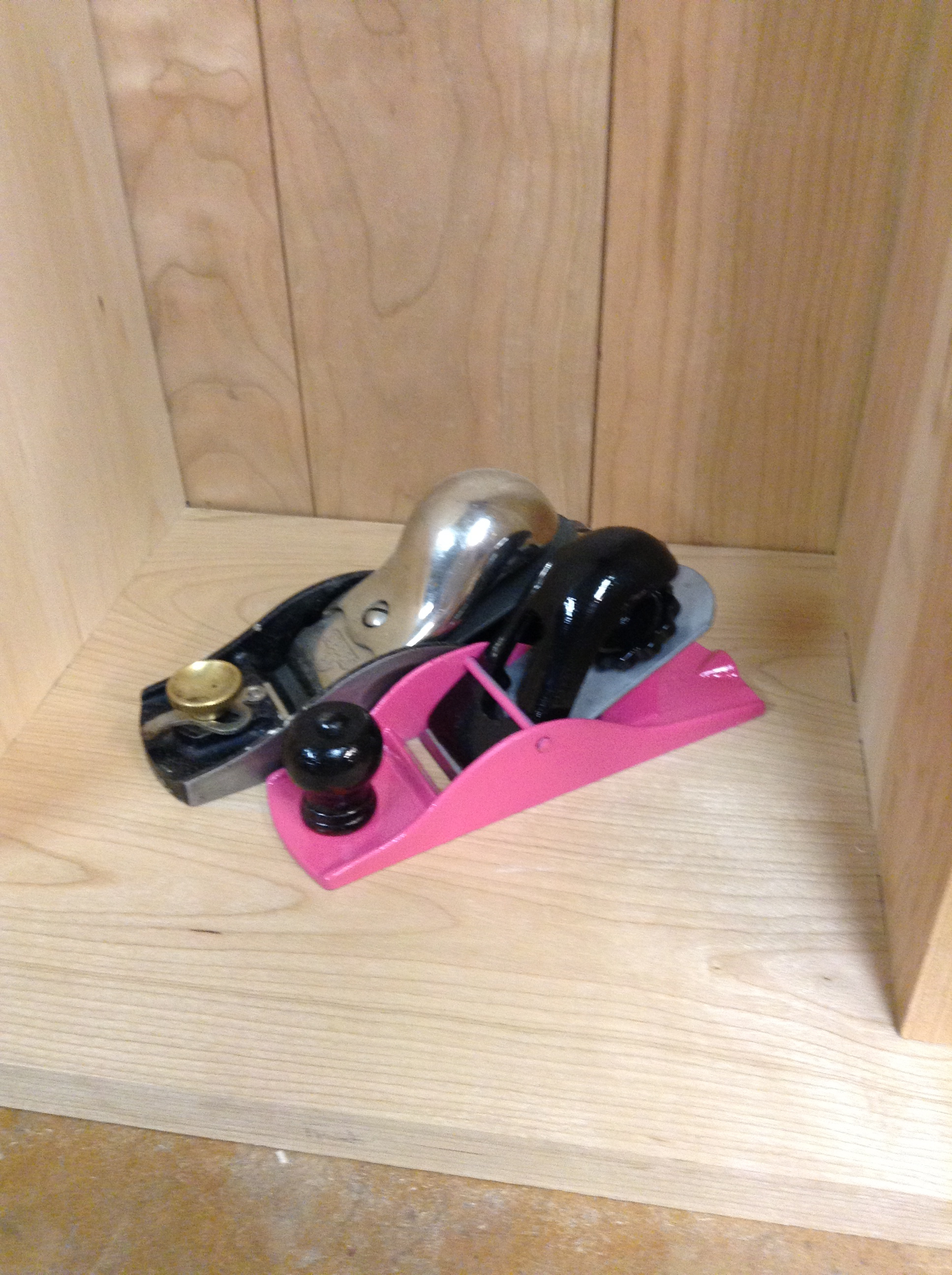
When Grandpa came for Christmas he brought along a couple of special gifts. A gentleman’s saw, block plane and this very unique and highly prized pink block plane. If you want one like it, you’ll have to make your own, but for now enjoy the picture of the one that resides in my daughters hand.
Back of the Saw Till
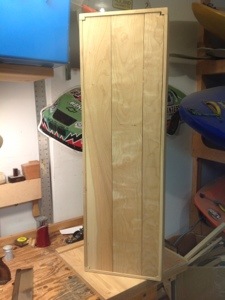
Several weeks ago I began the process of building a home for my handsaws. Admittedly I don’t have a handsaw problem…yet, however I do have a tool problem. I need a home to store them safely and this is why I have been building the tool chest and along the way a saw till. Following along with Shannon Rogers and the Hand Tool School I have built the saw till carcass and have reached a point where I need to prepare and install the back.
I prepared three boards approximately 1/2″ thick and then planned to cut a rabbit in the back of the carcass to support the boards.


Cutting the Rabbit along the inside of the carcass did not turn out as simple as it first appeared. Working without a plan sometimes gives you unexpected opportunities. In the case of the saw till the first chance to try a new skill came when I realized that I had not positioned the dovetails to hide the rabbit. I now had the job of cutting stopped rabbits that would not be exposed on the sides of the carcass.
I used my skew rabbit plane to cut the majority of the groove then using a chisel to finish them up leaving some material in the corner. Took a little more time than it should have, due to the chisel work but I am pleased with the result.
The back will consist of three boards and I have a choice of ship lapped joints or tongue and groove for their installation into the rabbit. After my great experience with tongue and groove on the tool chest bottom boards I decided to try it again on this project.
 I installed the 1/4″ cutter on my plow plane and proceeded to plow a groove on one side of the two outer boards. The other edge of these boards will rest against the carcass. I then notched the corner of these boards to fit the notches in the carcass.
As I mentioned in a previous post making the tongue for the joint using the veritas plow plane requires the installation of the conversion kit and blade. This is a simple process and only takes a couple of minutes to complete. One caution…clear an area of the bench so you can spot the screws and washer. I managed to drop the washer in a pile of shavings and for a couple of tense moments thought I had lost it. The pictures below show the additional skate which is part of the conversion kit. It is installed onto the plane and the blade fitted between this skate and the main skate.


After 10 minutes I have placed a tongue on both sides of the middle board and installed all three into the back of the till. A few more parts and I can get my saws safely off my bench and out of the way.

Different Plane – Different Shavings
If you haven’t noticed I take a lot of pleasure in watching the shavings curl up from a plane. There is something magical about moving a piece of iron across a board, watching shavings curl up past your hand and seeing a groove or rabbit appear behind. This is something that I missed when I was using power tools exclusively. As I reflect back over the last year I am also realizing that unless you are performing a repetitive task using the hand planes is not much slower. Let me introduce you to a few of the planes in my tool box (soon to be tool chest).
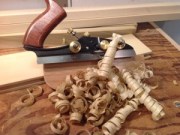
Plow plane – This has to be my favorite specialty plane. I use a Veritas Small Plow Plane available from Lee Valley Tools. A couple of months ago I really extended the usefulness of this plane by adding on the conversion kit which adds on an additional skate and allows you to use wider blades and most importantly cut tongue and groove joints. The second addition to this plane is the fence attached to the side. Veritas manufacturers the plane with holes for this attachment and I strongly urge you to add it soon after purchase. It greatly enhances the planes stability and therefore accuracy.

Skew Rabbit Plane – Moving Fillister or Rebate Plane. Lots of different words for this plane and yes they do have meaning. I have two rabbit planes a Stanley #78 and the Veritas Skew Rabbit Plane (pictured). Both of these planes are very capable of producing rabbits of varying widths. I find the Stanley #78 to be finicky and I have trouble maintaining the setting (mostly my fault, not the plane’s). When I first purchased the Veritas skew plane I had difficult leveling the blade for a 90 degree rabbit. I have since fixed this by paying more attention to the set up and adding a fence just like I did on the plow plane. What makes this plane a moving fillister is the addition of the spur which scores the work prior to cutting. This makes for a very clean crosscut. The skew blade pulls the plane tight against the face and cuts easily through the wood and the shavings are super cool…..
I have a fairly complete arsenal of planes, the vast majority of them used Stanley’s and I would have it no other way. Bringing a plane manufactured in the late 1800’s back to life and producing the same shavings as was made by a proud owner 200 plus years ago is a special feeling. I found that when buying used planes on Ebay or at tool meets, the standard planes are reasonably priced and readily available it easy to tell the condition of the planes and parts are available. The planes above were tougher to find and priced much higher (if you are on the East Coast you may have better luck). When putting together the Stanley #78 I had to go to two separate places for the fence and cutter. When you add in the shipping and parts there was not a lot of difference in price. The planes above are obviously new and were purchased after looking for their equivalent used counterparts. I decided that due to the complexity of these planes, difficulty in determining condition of the used planes and availability of parts that I would buy new. That was my personal decision and If you are looking for used planes there are many sources on the web, a great one is Hperkitten.com. If you haven’t found Patricks Blood and Gore you need to look. The other source is my father in law who does an excellent job of finding gems, but I’m not sharing that contact.
Tool Chest – Lid Panel
Completing the Tool Chest lid requires preparing the panel to be inserted into the frame and adding the dust seal. I cut the panel to size and using my #4 plane smoothed the edges including the end grain. I remembered to work the end grain from the edge in to the center from each end to prevent tear out. Next is a groove around the panel to insert into the groove in the panel. Another excuse to use my plow plane. This is quickly becoming one of my essential go to planes. Couldn’t miss the chance to show a different type of shaving.
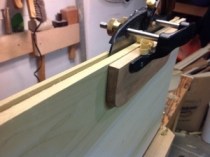

I used the same set up to tackle the end grain with the exception that I needed to be very careful not to tear out the end of the goove. By stopping short of the end the skate forced the plow plane upward at each pass leaving the groove in the first photo. Since the groove was not in the exact middle of the board I cut both end sections before adjusting the plane to reverse direction and clean up the rest of the groove in each end. The plane worked beautifully.
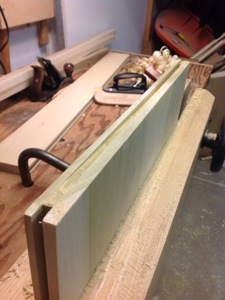

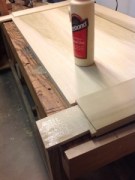
Next step was just glueing and clamping the panel. I had to take it inside after gluing so that there was enough warmth for the glue to set properly. Tomorrow the dust seal.

Scrub Plane vs Fore Plane
It’s cold today with fresh snow on the ground making it brighter and more cheerful outside. I’m struggling with a cold of my own so instead of heading out to the garage I have been sharpening and cleaning tools. I have been using a Stanley #6 for rough work. It is hefty and feels good in my hands and it quickly brings a delinquent board under control. The blade is cambered to an 8″ radius and it does not get sharpened very often, but today the blade sparkles with a new edge.
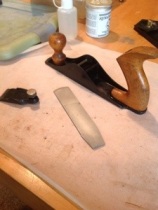 I cleaned and sharpened one of the planes that my Father in Law dropped off, a Stanley #40. It is in great shape and I particularly like the beech handles, the color stands out boldly against the black Japanning.
I was surprised when he handed me the plane because it is quite small and quite the opposite of the hefty #6. The blade has a camber that must be closer to 3″ and is in excellent condition. I sharpened both it and my fore plane because I wanted to understand where each tool would fit into my work and the best way I know to do that is to put them to work.
Digging through my scrap box I came a cross a piece of poplar that would serve my purpose and dogged it down on the bench. The scrub plane took bold cuts diagonally across the board leaving gouges that are typical of the heavily cambered blade. I worked about 1/3 of the way across the board and into an area that I new was cupped. The plane kept moving material across the board with no hesitation. Next picking up the fore plane I finished taking cuts across the board. It wasn’t long until I noticed that the cup in the middle of the board was deep enough for the longer plane to bridge across and only shave the two edges of the board.
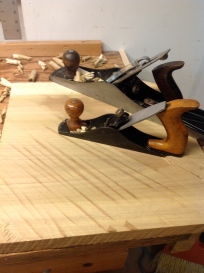
If you look in the picture below you can see the change in color of the wood where I stopped using the scrub plane and switched to the fore plane. So I sat down on the old 5 gallon bucket to think. If you have read my blog you’ll notice that I use the bucket quite a bit, one day when I find the right plans I will be sitting down on a stool, but for now the 5 gallon bucket will have to do. The planes have done exactly what you would expect. The longer bed of the fore plane allows it to bridge across the undulations of the wood and work to flatten the entire board. The shorter scrub plane only bridges a very short distance,so in the case of this board it has done a fabulous job of shaving the thickness of the board but as for flattening, i’m not so sure. Adjusting the blade depth would certainly make a difference, as would changing the camber of the blade.
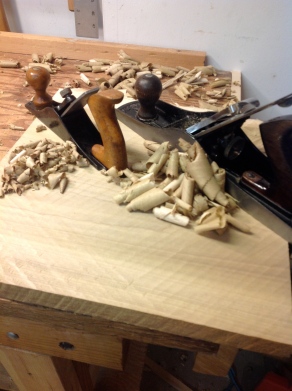
The heavier fore plane is a beast when it comes to “hogging’ waste and once moving it is difficult to stop, exactly what I want when trying to level and thickness a board, but I think for narrower boards and smaller work the scrub plane has a place. I’ll keep trying it in different situations and refining its place in my tool box. In the mean time enjoy the photo of the different shavings and certainly the color of the tote gives it a striking appearance. If you have thoughts on these planes please comment there’s a lot to learn.
Tool Chest Lid – Mortises
Woodworking presents challenges and different techniques on a regular basis. Often it is as simple as planing figured wood or getting a great fit with a dovetail. Today presents an entirely new challenge cutting a through tenon. I have made plenty of mortise and tenon joints, even some that looked great, but I have never made a through Tenon. Follow along and feel free to critique.
 The lid of the tool chest is of frame and panel construction. All of the boards are 7/8 poplar and I spent time ensuring they are square and smooth. Laying them on the chest I marked the lengths with my marking knife around the entire board and then used my paring chisel to prep the edge for a first class saw cut.
After sawing all of the frame boards to length I cut grooves to receive the panel into each side of the frame boards. I really like using my plow plane to cut these groves. There is something calming in the sound of the plane slicing through the wood and feeling it curl up past my finger tips. In about 15 minutes I have plowed grooves in all four boards and am ready to cut the tenons.

I placed the boards on the tool chest again to mark the location of the tenon joints. If you are a 100% hand tool person skip the next sentence. I took each of the frame boards over to the table saw and cut the tenons. After all it was 30 degrees in my shop. Cleaning up each of the tenons with a block plane only took a few minutes and I test fitted in the groove plowed earlier. I’ve been researching making through tenons for the last several days without a Lot of luck. I did stumble across a very neat video from Paul Sellers showing a side view of his method for cutting mortises, this is the method that I intend to use. I also plan on marking the mortise on each edge of the boards and cutting from each side to prevent tear out.
Many of my tools are used and have come from estate sales, yard sales ebay, hand me downs etc. I looked for mortising chisels for quite some time, even through the piles of chisels at the Midwest Tool Collector Association and decided to purchase new. Pricing was not much different so last summer I ordered two new chisels from Lie-Nielsen, the first mortise chisels I have ever owned. This was my chance to put them to use making a very deep tenon.
 The mortise is marked out using my marking gauge and knife being careful to account for any minor differences in the width of the mortise sides. Using my paring chisel I carefully removed material adjacent to the marks then chiseled out the first 1/4 to 1/2 inch. Turning the board over I transferred my marks from the front edge to the back and marked the mortise location in the groove. I could never have done this with a pencil. Taking out my drill I attached a 5/16 auger bit and proceeded to drill out the waste. I drilled within 1/2″ of the mortise on the other side. Next using my mortise chisel and bench chisels I removed the rest of the waste. Well that’s the way it worked in two of the mortises……Fortunately two of them will be covered by the dust seal. I learned several things along the way; starting the mortise 3/8″ in from the side is two close. I split the side on the second mortise and moved the last two in to about an inch. Take your time on the initial cut. I took twice as long to do the third and the fourth and it shows. Practice..Practice.
Next step is the Panel for the lid, dust seal, then glue up. It’s starting to take shape.

Blue Spruce Toolworks – Awesome
Power tools have been the focus of my woodworking until approximately a year ago when I began enjoying the use of hand tools. Watching The Hand Tool School I realized that there was great value in the use of a marking knife over a pencil especially as you move into the use of hand tools. Browsing internet sites I came across Blue Spruce Toolworks frequently and realized that Shannon Rogers and others were using knives from Dave Jeske. After much contemplation I place an order which arrived a few days later. The knife is a work of art. The tiger maple and design of the knife are an inspiration and the knife is used on every project. If you have not made the transition to a marking knife go now. This was before Christopher Schwarz wrote his recent article about the knives.
A week ago I watched this knife roll across my bench and in agonizing slow motion teeter on the edge and dive blade first onto the hard concrete! I could do nothing since I had my saw till in one hand and saw in the other. The knife appeared OK but in use the blade had a slight wiggle. After a fall like that I probably would have broken an ankle. Not to overstate my emotions, but I felt a curtain of darkness drop. That knife was the first step into what has become an awesome journey into hand tool woodworking. I emailed Dave Jeske asking if the knife could be repaired and if he could smooth one side to prevent my stupidity. The next day I mailed it to Oregon and four days later a package arrived containing a box.
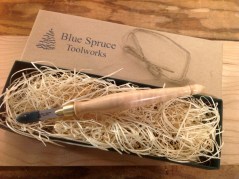

Beautifully wrapped was a marking knife and even better it had a flat spot carefully placed on the side. If you own one of these little beauties you will know how I felt. I searched the package and the box for a bill, there was none! Dave thank you for the excellent service, beautiful tool and small custom change. You are awesome! and If you think you will get away without getting paid… There’s a tool order on the way.
My Favorite Marking and Measuring Tools
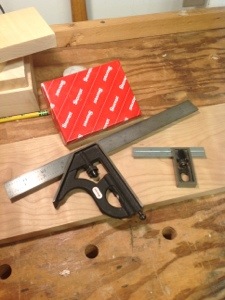
There are four squares in my tool box, two that I use every week, one that is used a few times a year and one that is my neighbor square. One more hangs high on my wall just in reach.
When I was 8 my father presented me with a few tools for Christmas; a hammer, two screw drivers (flat head and Phillips), a six inch adjustable wrench and a square. These tools were purchased from Sears and proudly have the craftsman name on the side. I still have all of these tools in my tool box with the exception of the hammer which remains in his tool box. All of these tools are still used with the exception of one……the square.
There is nothing special about the square it has a red plastic handle and metal edge marked off in inches. I used it until twelve years ago to build book shelves and beds and many other projects around the house. Until I went to a class on table saws at Highland Hardware. In this class they talked about setting up the saw and how to square the blade using a board cut on all sides to check for accuracy. As in most classes they pointed out the tools you could purchase from their store to help you master your craft including several machinists squares made by Groz. I didn’t need any tools since I had a nice craftsman square and besides I had just forked over cash for the class.
In my garage I went through the suggested set up for my saw and to my amazement it was not square. I repeated again and again, same thing. In frustration I sat down on a 5 gallon bucket and stared out my garage door. Three hours later I had a new 6″ Groz machinist’s square and a table saw that was cutting true lines. The old square was relegated to the back of the tool box. My woodworking took a dramatic leap forward as joints fit and I spent less time making adjustments.
I later ended up with a 12″ Stanley combination square that was accurate and could handle wider boards. The Groz was used on my machinery, it’s heavy weight helped it to stand accurately when adjusting blade settings and the Stanley combination square became my marking square . This worked great until we moved, and the Stanley square was misplaced. I replaced it with a similar square and ready to work checked it with the Groz, it was not square. I returned the square assuming it was unique and checked the entire store stock about 8-10 squares. None of them were accurate!
Back to the 5 gallon bucket for some contemplation and after some research a red box showed up at the house with a Starret 12″ square. This was another leap since it operated smoothly was easy to ready and had a definite feel of quality. The Starret squares are not low cost but they are worth every penny. A year later another red box arrived with a 4″ Starret square. It is now my favorite; used for marking joints, checking edges for square and many other tasks. The message in this blog is purchase the most accurate measuring and marking tools you can, they affect every cut you make.
I almost forgot my neighbor square. I am happy to loan tools to my friends that understand their value not only in cost but the joy they give me. I am even happier to go aong and give them a hand. However, I have not loaned out my Starret squares, but I do keep an old combination square for their use. There are some tools that mean that much.


 orepass