Archive
Small Tool Chest – Half Blind Dovetails
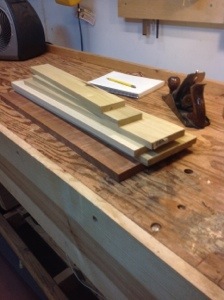 I have a fair amount of confidence in my through dovetails. Generally they come out well and only occasionally do I have to make a repair or repeat a cut. Half Blind dovetails is a different experience. In fact I have no experience at all and when I have made drawers that required a clean face I have made through dovetails and used a face board.
I begin by preparing stock for the two drawers. The front of the drawer is obviously Sapele. The sides and back could be Sapele, but I like the look of contrasting woods so I dig through my offcuts and come up with poplar and Oak. The key to any dovetail is to begin with well prepared stock that has square edges.I carefully plane the sides then take a few minutes to sharpen my blade and smooth the end grain. Two years ago I would have hesitated before planing the ends and left them to the saw cut from a table saw. Now I just sharpen the blade and plane three quarters of the way across from one side, Reverse the board in the vice and finish up the work . There is something particularly satisfying when smoothing end grain. The blade makes a crisp sound and if all is right the grain comes away like flowers of a petal.

The next task is to lay out the dovetails and sides. Experience tells me that the clearer you mark your work the less chance for a mistaken cut. I always take the time to mark each line and then mark the material to be removed with an X. It guides the cuts, ensures I place the saw on the correct side of the line and reveals what the work should look like when completed. In the picture you can see that I am using a backer board for the cut. This board will be used to transfer the cut lines from one side of the drawer to another ensuring a perfect match.
I saw out the tails for both sides of the first drawer and then pause realizing that I need to resharpen my saw. I’ve been sharpening my own saw’s for the past year and have found it a fairly easy task. I tend to wait too long before resharpening saws however, making the task more difficult than it should be. After five minutes I finish off the tails for the second drawer and begin layout of the pins. This is where I am moving into new territory with the half blind pins.
I am following Paul Seller’s method that he demonstrated when I was in his class. I’m certainly glad that I took detailed notes and follow them for this task. There seem to be many ways to cut all manner of dovetails and it is fun to look around the internet and listen to people’s passionate explanations of
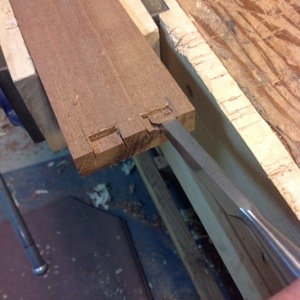 how their method is best. This is the only way I know how to cut half blind dovetails so I have no experience for comparison. It takes me a couple hours to chop out and fit all of the pins and when I am done I am fairly satisfied.
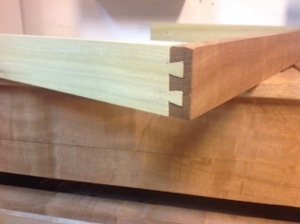
My only regret is not using the red oak for all of the sides. It is much prettier and I am more satisfied with the crisp lines that I leave after chopping away the wood.
A tense moment Small Tool Chest
Before I attached the lid of the tool chest I marked the cut line for the lid. I’m now physically prepared to make the cut. Notice I say physically, the chest is positioned, saw is sharp, cut lines marked……mentally however I’m a little concerned.
Sawing a straight line all the way around the carcass looks to be a little tricky so I clamp a guide to help me get started. Then using a panel saw I progress one edge at a time around the chest. Changing my hand hold on the saw gave me more control as I attempted to stay between the marks. Finally the cut is complete. I’ll need to take some time with a plane to clean up the edges, find some hinges, then I can begin the drawers.


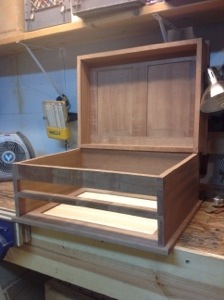
A Defining Moment – Lid Attached
Attaching the lid is similar to the bottom with the exception that I will not use screws. I don’t want the plugs on the top of the chest and it is not supporting much weight. The challenging part about the lid attachment is the preparation I need to make for the following step, separation of the lid from the carcass.
There is a very slight bend in the front board of the chest and I realize that I can take the bow out when I attach the lid but when I saw it apart the bow will return to the lower portion. To prevent this I measure the upper shelf and cut it to size. After the lid is separated I will be able to squeeze the shelf into place on the lower part and know that it is not bowed. The shelf is made from 1/4″ mahogany plywood. I use a marking knife to ensure there are no splinters.


After sharpening my plane, time is spent smoothing the carcass and ensuring the lid fits leaving no gaps. I enjoy the sound of the plane as it slices through the grain and it only takes a few minutes to smooth everything. A sharp blade is a must when doing this work.
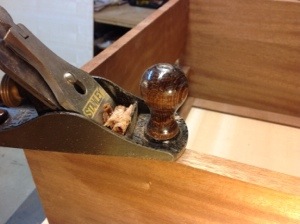
When the Dovetails were laid out we left a thicker tail where the lid was to be separated. Using my marking gage I locate the larger tail and mark off the location of the cut. It is 1/8″ wide and I cautiously mark around the entire carcass. I have worried about forgetting this step since to glue the lid on prior to marking would be a major problem. Marking a 1/4 inch around the lid I use my plane to form a round over, then I’m ready for glue up.
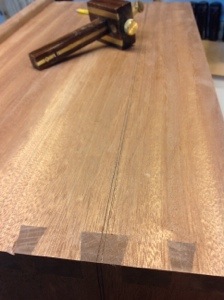

 There is a defining moment in each project when you can see the finished project. Now that I have the carcass, bottom and lid in place I can step back and look at the dimensions and evaluate the chest. I like the way it looks and the simplicity makes the joints stand out. The next stage is to separate the lid and build the drawers. First I carry the chest into the house so that the glue can bond where it is warm!
Attaching the Bottom, Small Tool Chest
Fall is definitely yielding to the incoming winter today. I wandered into the garage this morning and it was a balmy 38 degrees (3 C) and after turning on the heater, wandered off to walk the dog. Hand work is a little tough when it is this cold and giving the heater an hour to take the chill out of the air will make a big difference. Outside the temperature is hovering in the low teens and the ground crunches under my feet from the heavy frost. The cool breeze on my cheek, beautiful blue sky and quiet of the morning make up for the chill.
Back inside I realize that I need to make some progress today and get the top and bottom lids finished and glued up. Hopefully this will put me in position to get the drawers done after Thanksgiving.
Spending quite a bit of time on the carcass I check the fit and finish, look for alignment issues and any gaps. Once the bottom is attached it will become much more difficult to scape away any tear out and any gaps will become a permanent reminder of a rushed morning.
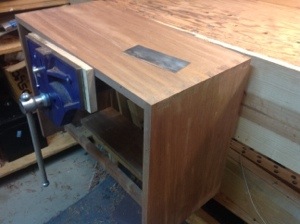
Placing the entire carcass in my vice makes the entire process much easier. When I bought the vise earlier this year I debated on the size I needed . It seemed a little extravagant to purchase one with a 15″ opening at the time but I have not regretted it. As I work the piece with planes and scrapers it is rock solid, at a great height and easy to reposition. My only regret is that I wish I had mounted it a 1/2 inch further out from the bench to allow more room to get my fingers behind a board.

I test fit the bottom and make some more adjustments to remove any gaps and then prepare for the glue up. The bottom will be attached with glue and screws to ensure that it can support the weight of the drawer above. The screws will be counter sunk and I will plug them at some point. Once glued, I placed the box inside to allow the glues to cure at a reasonable temperature.
Small Tool Chest Raised Panels
 Until 6 months ago I would have never considered making raised panels with a smoothing plane. Actually, I would not have a plane sharp enough to make raised panels. The bottom panel is a piece of 1/4″ plywood. It will never be seen and the chest is quite heavy without the additional weight of a panel.
Making raised panels is much quicker by hand unless you are making a large number. It took me 15 minutes for each panel for a total of 30 minutes. I don’t think I could find my router bits in that time. The most frustrating part of this process has been trying to flatten the panels. We have been through multiple weather changes since I first cut the panels and I have planed them flat twice and one of the has a vicious cup already.
Once flattened I mark out the desired thickness of the panel edges using a marking gage and then pencil in guide lines for the raised panel on the top. Placing the panel in my vise I plane back and forth at my desired angle careful to maintain a 45 degree cutting angle on the end grains. I repeat this for all of the sides on each panel. Next I flip the panels over and repeat the process until the panels fit neatly into the grooves. Glue up next.

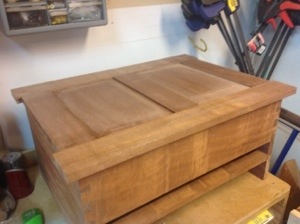
Small Tool Chest Bottom
The bottom of this tool chest is a frame like the lid, with a single panel. Looking closely at the grain I took a chance and decided to split the waste from the tenons using a chisel. This is definitely my preferred method to remove the waste and if all goes well, much quicker.
Grain direction is the critical element when using a chisel to remove the waste. After laying out the tenon and sawing along the bottom I look at the grain and try to determine where it will split. If the grain looks like it will split into the tenon I stop, grab my saw and cut the tenons. If the grain looks like it will split parallel to or away from the tenon I place the tenon in my vise and make some test cuts.
 I place my chisel approximately half way into the waste and and on one side and give it a tap. Watching the split I can confirm that the wood will split where I intend. I then move to the other end and a place my chisel half way and make another test tap. If this works I go ahead and remove the waste. Using this method of checking each end of the tenon has been particularly helpful with the Sapele. The grain can change dramatically over a few inches and where I can use a chisel on one end of the tenon I may not on the other.
I saw two of the tenons and split the other two and quickly finish the mortise and Tenon joints. Most of the joints fit well, but I still have a little bit of work to smooth the joints. Rigging up a clamp n my vice I am able to support the bottom while I use a plane and cabinet scraper to smooth all of the parts. Sapele has been fun to work, but I could never have gotten by without my cabinet scraper.

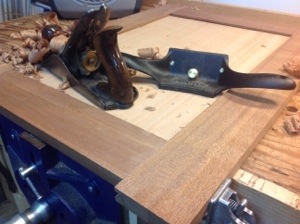

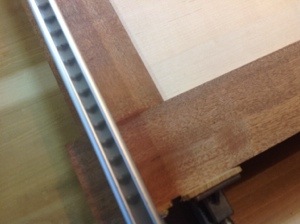
Lid – Small Toolchest
One of several features in this project is the design of the too chest lid. The lid teaches the methods necessary to make a door with mortise and tenon joints and raised panels. Knowing that I need to develop a twist free lid I begin this stage by making a mortise guide. Similar to the guide I made for the table project, I begin with a scrap piece of ash with the grain running vertically and then carefully cut and plane a piece of Oak to 1/4 inch that will be placed as a guide for the chisel. I learned from my first guides that grain direction and wood choice is critical. The vertical grain on the ash will prevent bending and the horizontal grain on the oak will resist wear.


The guide which is a Paul Sellers Design works brilliantly when you need a perfectly straight mortise. With the guide gluing, I turned to the rails and grabbed my plow plane to cut grooves for the panels. It took me approximately 45 minutes to cut all of the grooves for the top and bottom panels. If I had sharpened up when I began, instead of waiting until the last couple of pieces if would have gone much quicker.


With the grooves in place I turn my attention to marking up all of the mortises and tenons. This is definitely an area where I have a high probability to make a mistake, so I slow down, double check my measurements and think carefully through the process. Wild doing the marking I ganged all of the rails together to ensure that the markings are precise from one to another. Also I work from one end only, eliminating errors that may come from slight deviations in length.


With six mortises and tenons completed the chest design begins to come to life. Next, the bottom and raised panels!

Enhanced Dovetail – Small Tool Chest
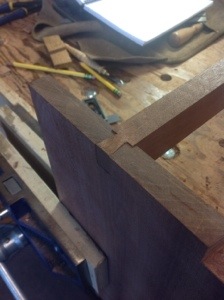
The center rail between the drawers is a combination of mortise and dovetail. Not a particularly difficult joint but since it is at the front of the chest very visible. The basics steps for the joint are to lay out the mortise using the center rail for size. Then I carefully chopped out the edges of the mortise, finishing up with my hand router to ensure a smooth and even mortise. The tail is marked onto the rail with my marking knife and using a hand saw and chisel cut to size. Carefully fitting the rail into the mortise on the one end, I then repeated the process on the other side.
After planing the joint smooth I’m content with the result. A little more practice and this will add a unique feature to other projects.
A Quick Repair

While taking one of the small tool chest sides out of the vise it slipped from my hands and hit the floor. Of course it landed on a corner, and as always it was the corner that would be most exposed. Looking at the damage to the corner I considered if it could be left or needed to be repaired. Replacement of the board is not an option because it is a tool chest for myself, the wood is expensive and repairing the damage would be a fun challenge.
I’ve made a few repairs over several years some successful and some looking worse than the original damage. I am a repair amateur but willing to learn. This corner looked like the perfect opportunity to trim the damage off and insert another piece planing to fit. Searching through my scraps I found a piece of wood that appeared to have similar grain. Next I cut and chiseled off the piece that I wish to replace and cut a replacement piece.Trimming carefully with a chisel I attempted to match up the replacement piece to the wood. I the glued it in place and used tape to hold it while the glue dried.
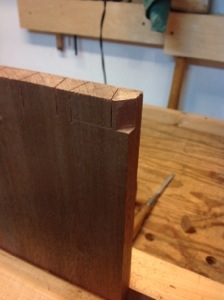
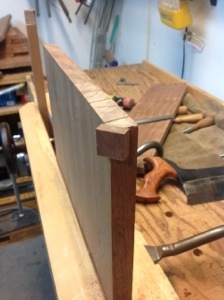


A little work with my smoothing plane and the repair is in place. Not a perfect match but when the lid is glued on top I don’t think it will be noticeable. Now if I can avoid dropping anything else………
Small Tool Chest
Uncut boards stacked on a bench, notes jotted on a page of paper, and tools freshly sharpened ready for work, bring a sense of anticipation into the shop. Taking a few moments I run my hand down the rough boards and think about the trip they have taken and the sights they have seen. One of the gifts of working wood by hand is a sense of respect for the lumber and an intimate knowledge of the way it has grown and the life it has seen. Not to say that working wood with machines doesn’t bring this respect for others, just that it was missing when I used them. I rarely took the time to feel the grain, study the best way to plane a board and listen to the planes and chisels for messages on how to proceed.
Today I’m starting on a new project that I am very excited about, it’s a smaller tool chest designed by Paul Sellers and is part of his masterclasses series. There are many unique features and as I build I’ll share what I can. I went to a new lumber yard and spent some time looking a several options for the tool chest. Many of you may disagree with the choice, but I chose to build in Sapele. Yes expensive; however I hope to be looking at this chest for a very long time.
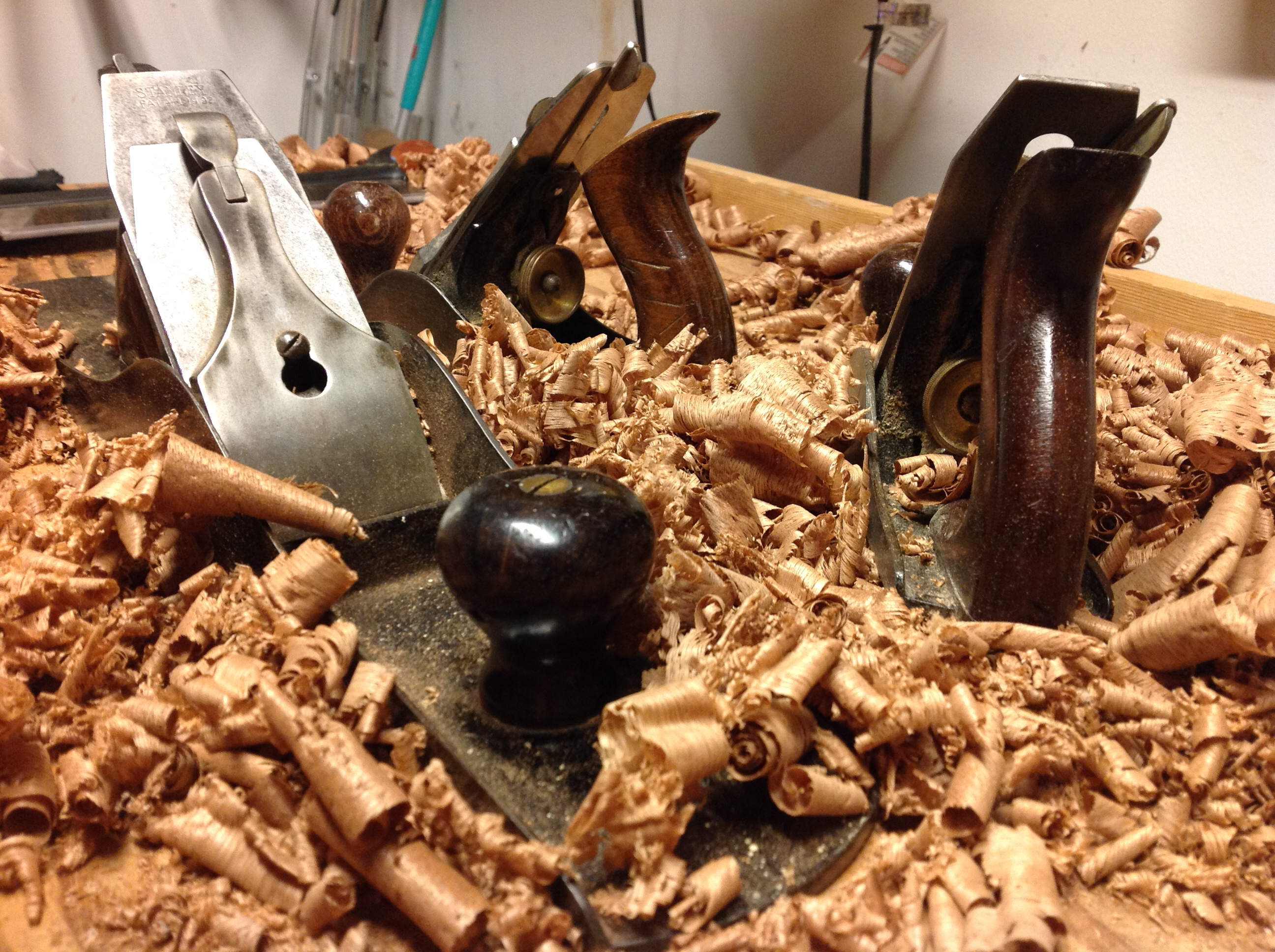
I cut the boards to rough length, planed one side by hand and the other by machine and set out to glue up the panels for the sides. For the last couple of projects I have been planing one side by hand to remove any twist or cup. I do have a jointer, but I find it easier to flatten one side by hand. It’s also a lot more pleasant than listening to the roar of the jointer. Flattening one side of the board could easily be done with one plane, but if you have a jointer and smoother why not use them. In this case I used a Stanley #7 and Stanley #4 and because I like the little guy, the #3 for the edges. No, I did not stage the picture. This is just where they ended up when I was done.
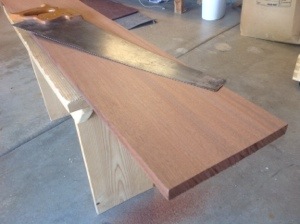
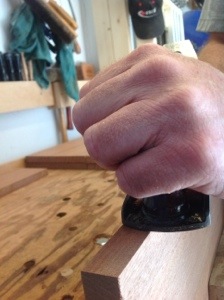
I enjoy working different woods and learning how they react to the tools. Sapele planes beautifully and although the grain is very complex I had little tear out. I do anticipate some later on. The smell of the lumber has caused me to founder for a memory. It is very distinct and hopefully sooner or later I will find the lost memory.
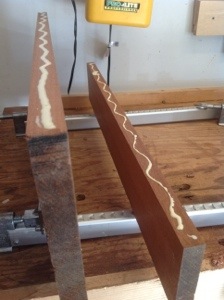
I glued up three panels for the two sides and the back of the chest. They are 11 3/4 inches high and in a short time I was able to plane the edges square and glue the boards together. I am really enjoying my new clamps. in particular I like the handle used for tightening them. I have never like the design with the through pin that slides back and forth on my previous clamps.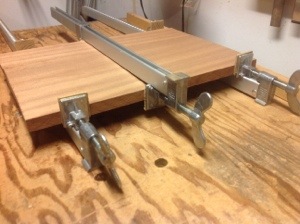


 orepass